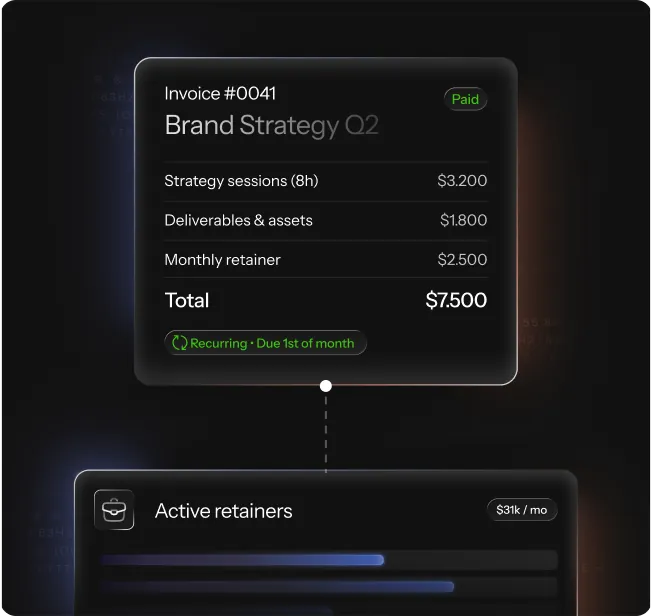
Agencies and consultants are paid in large, irregular amounts: projects, milestones and monthly retainers. Lumino sets up a merchant account that expects high-ticket card payments, bills retainers automatically through recurring payments, and offers clients payment plans on bigger engagements.
Subscriptions charge a retainer to the client’s stored card each period and send a receipt, with a retry and a flag on the account when a payment fails.
Payment plans for larger engagements
Split a project fee into a deposit and scheduled installments, collected from the client’s card on file on dates they have authorized, with every plan’s status in one place.
A creative agency wins a rebrand and agrees on a deposit and staged payments with the client. It sends an invoice with the deposit due at kickoff, and the client’s finance contact pays by card from the email. Reminders follow the agency’s schedule, and paid invoices pass to QuickBooks through integrations.
A marketing agency rebuilds and resends the same retainer invoice every month. It moves the client to a subscription for the agreed amount and interval. The client authorizes it once, the card on file is charged each period with a receipt, and a failed payment is retried and flagged instead of going unnoticed.
An independent consultant sends a few large invoices a month and worries that a big card payment will be questioned. At onboarding the consultant shares typical invoice values and client types, so underwriting can review them up front. A client who asks to spread a fee pays in scheduled installments on a card on file.
For agencies and consultants, that means retainers and large invoices paid by card through an account that expects them.
A recommendation, with reasons
We look at how you sell and suggest a setup, and we say so when another option would suit you better.
Systems named on the page
The point-of-sale systems and integrations we work with are listed by name, so you know what you would be running.
Who handles the card data
Card data is handled by Lumino’s processor and gateway partners. The Trust Center explains the split.
A team you can reach
Sales and support each have a direct line on the contact page.
FAQ
Agencies&Consultants:questions,answered
Should an agency accept credit cards for large invoices?
Many clients prefer it, and card payments usually arrive sooner than bank transfers. The trade-off is the processing cost, which is why the pricing model and ticket size should be reviewed together.
How do I automate retainer billing?
Create a subscription for the retainer amount and interval, have the client authorize it once, and the charge runs each period with a receipt.
Can an agency earn from referring clients to Lumino?
Yes. Agencies are one of the partner types in Lumino’s program. See the partners page.
Which Lumino products does an agency need?
The usual set is invoicing for project work and subscriptions for retainers. Card-on-file supports payment plans on larger engagements, and payment links are useful for a one-off workshop or audit. They all run on the same account, so you add what you need as the client list changes.
How do I get started, and what does underwriting look at for an agency?
You fill in one application about the firm and how it bills. For an agency or consultancy, underwriting usually reviews the owners, the services you sell, typical and largest invoice values, the kinds of clients you serve, and recent statements if you have them. Approval is decided in underwriting. Faster merchant onboarding describes the steps.
What does it cost to accept cards on large invoices?
It depends on the pricing model your account uses and on your invoice sizes and volume. Lumino’s published figures are on the pricing page. A savings analysis based on a recent statement shows how the models compare, which is worth doing when each payment is large. The interchange entry explains one of the main components of card costs.
Can I keep HighLevel, QuickBooks and my other tools?
Yes, in most cases. Lumino lists HighLevel, QuickBooks and Zapier among its integrations. The route depends on your processing setup, so we confirm it for your stack during onboarding. Agencies that set up payments for clients on different platforms can ask about each one the same way, before anything is promised to the client.
How are disputes on large client payments handled?
You are notified when a client’s bank raises a dispute, and you can refund, accept or contest it. For services, the useful evidence is the signed proposal or statement of work, the invoice, proof of delivery and your correspondence. Risk & Disputes tracks deadlines case by case. The chargeback entry explains how the process works.
Can an agency use dual pricing on its invoices?
Sometimes, where permitted. Dual pricing presents a card price and a cash price and is mostly used by in-person sellers. Whether it, or any card fee, can be applied to an invoice depends on card network rules and state law, so check the rules that apply to you and your clients. Ask us whether dual pricing is practical for your firm.
How is Lumino different from Stripe or PayPal for an agency?
Lumino is set up with you by a team: the account is reviewed for your invoice sizes before the first payment, and there is someone to call. Whether that outweighs what you have today depends on how you work. Lumino and Stripe and Lumino and PayPal set out how to choose.