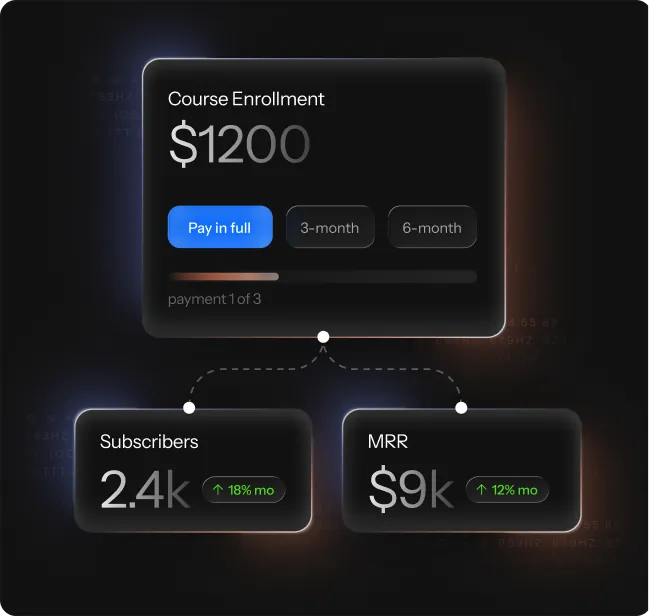
Coaches and course creators need a payment setup that expects large, card-not-present sales: a merchant account underwritten for high-ticket offers, ways for buyers to pay over time, and protection when a client disputes a charge. Lumino provides payment links, BNPL, payment plans and subscriptions on one account built for that model.
Affirm and Klarna for eligible buyers, plus your own payment plans.
Payment links for sales calls
A payment link sent by text, email or chat opens a hosted checkout, so the client enters their own card details while you are still on the call.
Subscriptions for memberships
Subscriptions bill monthly or annual access on the member’s stored card, with retries and notices when a renewal payment fails, and recurring revenue reported beside your program sales.
How Lumino compares with Stripe and PayPal for this model.
In practice
HowdocoachesandcoursecreatorsuseLumino?
01
Enrolling a client on a call
A coach ends a sales call with a prospect who wants the program but cannot pay the full price today. The coach sends a payment link with pay-in-full, BNPL on eligible purchases and an installment plan on a stored card. The client picks one before the call ends, and the terms they accepted are recorded with the payment.
A course creator plans a launch through a hosted checkout that will bring in far more volume than a normal month. Before the cart opens, they tell Lumino the expected sales, price points and refund terms, so underwriting can review the spike in advance. During the launch, alerts from Risk & Disputes flag each dispute as it is raised.
A creator runs a paid community beside a flagship course. Members join through a checkout page and authorize a monthly charge. Subscriptions bill each stored card on schedule and retry a failed renewal, and active and canceled memberships appear next to course sales in reporting.
For coaches and course creators, that means an account reviewed for high-ticket offers and launches before the first sale.
A recommendation, with reasons
We look at how you sell and suggest a setup, and we say so when another option would suit you better.
Systems named on the page
The point-of-sale systems and integrations we work with are listed by name, so you know what you would be running.
Who handles the card data
Card data is handled by Lumino’s processor and gateway partners. The Trust Center explains the split.
A team you can reach
Sales and support each have a direct line on the contact page.
FAQ
OnlineCoaches&CourseCreators:questions,answered
What is the best payment processor for online coaches?
The one that has underwritten your actual offer. Look for an account approved for your ticket size and delivery model, installment and BNPL options, and dispute support. The guide for online coaches lists what to check.
Why do coaches get their payment accounts frozen?
Usually because activity no longer matches what the provider expected: a spike in volume, much larger tickets, or a rise in refunds and disputes. Disclosing the model up front reduces the chance of a surprise review.
Can I offer buy now, pay later for a coaching program?
Often, yes. BNPL providers assess each business and offer, so eligibility is confirmed during onboarding. Approval of each buyer is the provider’s decision.
Should I keep my current processor as well?
Many coaches keep more than one way to take payments so that a problem with one does not stop sales. Lumino can be your primary account or a second option.
Which Lumino products does a coaching business need?
A typical setup is payment links for sales calls, a hosted checkout for launches and subscriptions for memberships. Card-on-file holds the client’s card, with consent, for installments. They run on one account, so you can turn on one piece now and add the others as the offer grows.
How do I get started, and what does underwriting look at for a coach?
You start with one application that describes what you sell and how. For a coaching business, underwriting usually looks at your programs and price points, how and when you deliver, your refund terms and, in some cases, recent processing statements. Approval is the underwriter’s decision. See faster merchant onboarding for the steps.
How much does payment processing cost for coaches?
It depends on the pricing model your account uses and on your volume and ticket size. Lumino’s published figures are on the pricing page and are not repeated here. If you already take cards, a savings analysis compares your current statement with what the available models would look like.
Can I keep using HighLevel with Lumino?
Yes, in most cases. Lumino lists HighLevel among its integrations, along with Zapier for tools that have no direct connection. The exact route depends on your processing setup, so tell us what you run and we will confirm what is supported before you switch. Payment links also work on their own, with no connection at all.
What happens if a client disputes a high-ticket charge?
You are notified and can refund, accept or contest the dispute. To contest it, you submit evidence before the deadline: the terms the client agreed to, proof of access or attendance, and your messages with them. No tool decides the outcome, but a consistent process helps. The chargeback management guide covers the practices that reduce disputes.
How is Lumino different from Stripe or PayPal for coaches?
The main difference is how the account is set up. Lumino reviews your offer, ticket size and delivery before the first payment and gives you a team to call. The comparison pages for Stripe and PayPal set out who each option tends to suit, so you can pick one or run both.