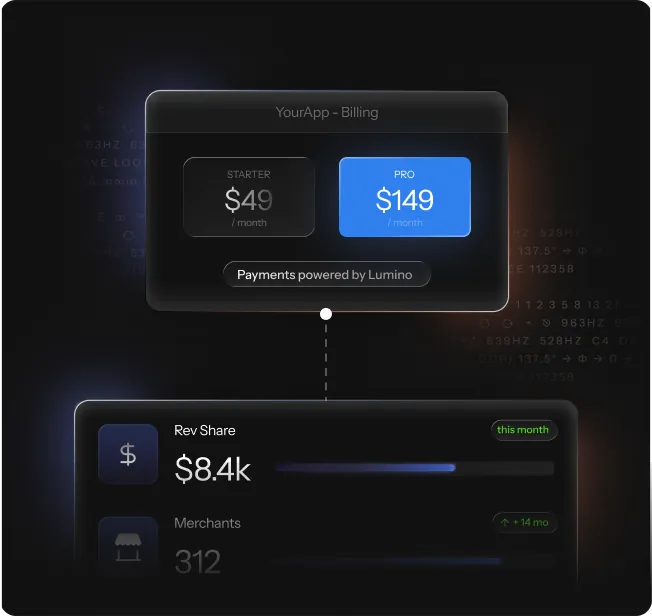
Software companies meet payments twice: collecting their own subscription revenue, and, for platforms, helping their users get paid. Lumino covers the first with Subscriptions and the second through a partner-led model or the enterprise platform program, so you can offer payments without becoming a payments company.
Customer cards are tokenized through Lumino’s processing partners and reused with consent, so plans and seats are billed to a card on file without raw card numbers sitting in your own systems.
Recurring revenue reporting
Reporting & Analytics shows renewals, failed payments and recoveries beside the rest of your payments, so churn caused by declined cards is visible and can be acted on.
A SaaS company suspects that some of its cancellations are really expired or declined cards. It bills its plans through Subscriptions, which retries a failed charge and flags the account so the team can contact the customer. Renewals, failures and recoveries then appear together in Reporting & Analytics.
A scheduling tool for studios keeps hearing the same request from its users: help us get paid. It does not want to become a payments company, so it joins the partner program and refers those merchants to Lumino for online payments. Underwriting and support sit with Lumino and its processing partners, and the referred accounts show in reporting.
A vertical software platform for the trades wants its users to take payments inside the product. It scopes an embedded program with Lumino’s enterprise team, covering how merchants are onboarded and how integration will work. Once live, Risk & Disputes tracks ratios per MID, and portfolio activity shows in reporting.
For software companies, that means subscription billing for your own revenue and a partner route for your users’ payments.
A recommendation, with reasons
We look at how you sell and suggest a setup, and we say so when another option would suit you better.
Systems named on the page
The point-of-sale systems and integrations we work with are listed by name, so you know what you would be running.
Who handles the card data
Card data is handled by Lumino’s processor and gateway partners. The Trust Center explains the split.
A team you can reach
Sales and support each have a direct line on the contact page.
FAQ
SaaS&Platforms:questions,answered
What are embedded payments?
Embedded payments means a software product lets its users accept payments inside the product, rather than sending them to a separate provider. The software company can do this by partnering with a payments provider instead of processing itself.
Do I need to become a payment facilitator to offer payments?
No. Registering as a PayFac is one route, with significant compliance and liability. Partnering or referring gives you payments in your product without taking on that role.
Does Lumino publish an API or developer documentation?
Not on this site. Integration options for platforms are scoped directly with the enterprise team.
Which Lumino products does a software company use?
For your own revenue, the products are Subscriptions, card-on-file and reporting. For your users’ payments, the choice is a referral through the partner program or an embedded program scoped with the enterprise team. You can start with your own billing and add the second part when users ask for it.
What is the difference between referring users and an embedded program?
A referral introduces your users to Lumino, which then serves them as merchants while you share in the revenue. An embedded program brings onboarding and payments into your product and is scoped with the enterprise team. The first asks less of your team; the second keeps users inside your product. See Enterprise platforms.
How do I get started, and what does underwriting look at for a SaaS company?
For your own billing you complete one application. Underwriting for a software company generally reviews the owners, the product, plan prices and billing intervals, trial and refund terms, and expected volume. For a platform program the review also covers the kinds of merchants you serve. Approval is decided in underwriting. See faster merchant onboarding.
How much does subscription billing or a platform program cost?
Subscription payments are priced on the model your account uses, and the published figures are on the pricing page. A savings analysis compares them with your current statement. Partner and embedded programs are commercial agreements scoped with the enterprise team, so their terms are not listed on this site.
Can I connect Lumino to the tools my team already uses?
For back-office tools, yes. Lumino lists QuickBooks for accounting, Zapier for automation and HighLevel for CRM among its integrations. Connecting your own product is a different matter: custom and embedded builds are scoped with the enterprise team and are not self-served from public documentation.
How are disputes on subscription charges handled?
You are notified of each dispute and can refund, accept or contest it. For subscriptions, clear billing descriptors, receipts, renewal notices and a simple way to cancel prevent many “I don’t recognize this” disputes, and the sign-up record is your evidence when you contest one. Chargeback protection covers the workflow.
How is Lumino different from Stripe for a software company?
Lumino is sold and supported by a team and reviews your business up front, and it does not publish an API on this site. If your plan is to build payment flows yourself, weigh that carefully. Lumino and Stripe sets out which kind of company each approach tends to suit.