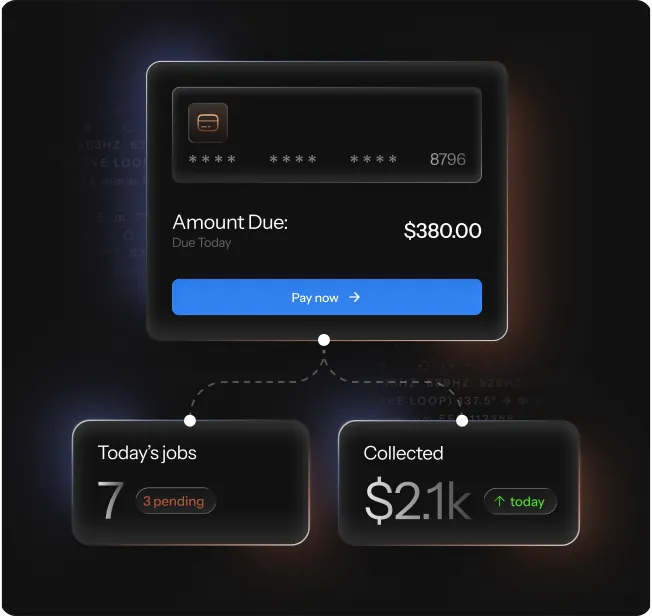
Home service businesses get paid faster when the customer can pay the moment the job is approved or finished. Lumino gives contractors, cleaners and technicians invoices with a pay button, payment links by text, a card on file for repeat visits, and recurring billing for maintenance plans.
Plumbing, electrical, HVAC, roofing and remodelling, quoted per job.
Recurring services
Cleaning, lawn care, pest control and pool service on a route.
Growing crews
Several technicians taking payment, one office reconciling it.
Common friction
Whatslowspaymentforhomeservices?
“Send me the bill”
An invoice posted later is paid later. A link at the door is paid now.
Checks and cash on the truck
Slow to deposit, easy to lose and hard to reconcile.
Big jobs, big up-front cost
Materials have to be bought before the customer has paid anything.
How it fits
HowdoesLuminofitahomeservicebusiness?
01
Quote and deposit
Send an invoice that asks for a deposit before work begins.
02
Finish and collect
Text a payment link or take the card on a handheld when the job is done.
03
Store the card
With consent, keep it on file for the next visit.
04
Automate the regulars
Bill maintenance plans on a schedule.
The stack
WhatdoestheLuminostackforhomeservicesinclude?
Invoicing with deposits
Invoicing that tracks partial payments against the job.
Payment links by text
A payment link sent by text opens a hosted checkout on the customer’s own phone, so a technician can collect at the door without carrying a card reader.
Card on file for repeat visits
Once a customer has agreed to future charges, their card on file can be billed for the next visit or an agreed balance, and each charge sends them a receipt.
A remodelling contractor has to buy materials before work starts. The quote goes out as an invoice that requests a deposit, and the customer pays from their phone. A customer who would rather spread the cost can choose BNPL on an eligible purchase, with approval decided by the provider and not by the contractor.
An HVAC technician finishes a repair while the homeowner is in the next room. Instead of promising to mail a bill, the technician texts a payment link from the driveway. The homeowner pays on their own phone, and the office sees the payment in reporting beside the day’s other jobs.
A pool service visits the same homes every week. Each customer agrees to future charges once, and the card is stored as a token. Subscriptions bill the maintenance plan on schedule. A one-off repair is charged to the same card on file, on terms the customer has already accepted.
For home service businesses, that means invoices, payment links and stored cards for work done away from a counter.
A recommendation, with reasons
We look at how you sell and suggest a setup, and we say so when another option would suit you better.
Systems named on the page
The point-of-sale systems and integrations we work with are listed by name, so you know what you would be running.
Who handles the card data
Card data is handled by Lumino’s processor and gateway partners. The Trust Center explains the split.
A team you can reach
Sales and support each have a direct line on the contact page.
FAQ
HomeServices:questions,answered
How can a contractor accept credit cards on site?
Either text the customer a payment link they complete on their own phone, or use a handheld terminal. Both record the payment against the job straight away.
Can I take a deposit before starting work?
Yes. A Lumino invoice can request a deposit up front and the balance on completion, both tracked on the same invoice.
Can I keep a customer’s card for recurring visits?
Yes, with their consent to future charges and clear terms. The card is stored as a token through Lumino’s processing partners.
Which Lumino products does a home service business need?
The usual starting point is invoicing for quotes and deposits and payment links for collecting on site. Businesses with repeat customers add card-on-file, and those with service agreements add recurring billing. Everything runs on one account, so you can begin with one tool and switch on the others later.
How do I get started, and what does underwriting look at for a contractor?
You complete one application describing your trade and how you bill. For home services, underwriting commonly reviews the owners, the type of work, typical and largest job values, how far ahead you take deposits, and recent statements if you have them. Approval is the underwriter’s decision. See faster merchant onboarding.
How much does it cost to take cards for home services?
It depends on the pricing model and on your job sizes and volume. Lumino’s published plans are on the pricing page. If you already accept cards, send a recent statement and a savings analysis will compare what you pay now with the models available to you.
Can I keep using QuickBooks?
Yes. Lumino lists QuickBooks among its integrations, so paid invoices can be passed to your books instead of being typed in twice. Zapier covers many other tools that have no direct connection. Tell us which scheduling or job software you use and we will say plainly whether there is a supported route.
What happens if a customer disputes a large job?
You are notified of the dispute and can refund, accept or contest it. For a job, the evidence that counts is the estimate or invoice the customer approved, the deposit record, photos of the finished work and your messages with them. Chargeback protection explains how alerts and workflows support that response. The outcome is decided through the card network’s dispute process, not by Lumino.
Can a home service business use dual pricing?
Possibly, where permitted. Dual pricing shows a card price and a cash price and lets the customer choose. Whether it suits invoices and payments taken in the field depends on card network rules and state law, so check the rules that apply to you. Ask us whether dual pricing fits your trade and your state.
How is Lumino different from Square for a home service business?
Lumino sets up invoicing, links, stored cards and recurring billing on one account, reviewed for your job sizes before you start, with a team to call. Square is also one of the point-of-sale options Lumino offers, so it is not an either-or choice. Lumino and Square explains how to decide.